

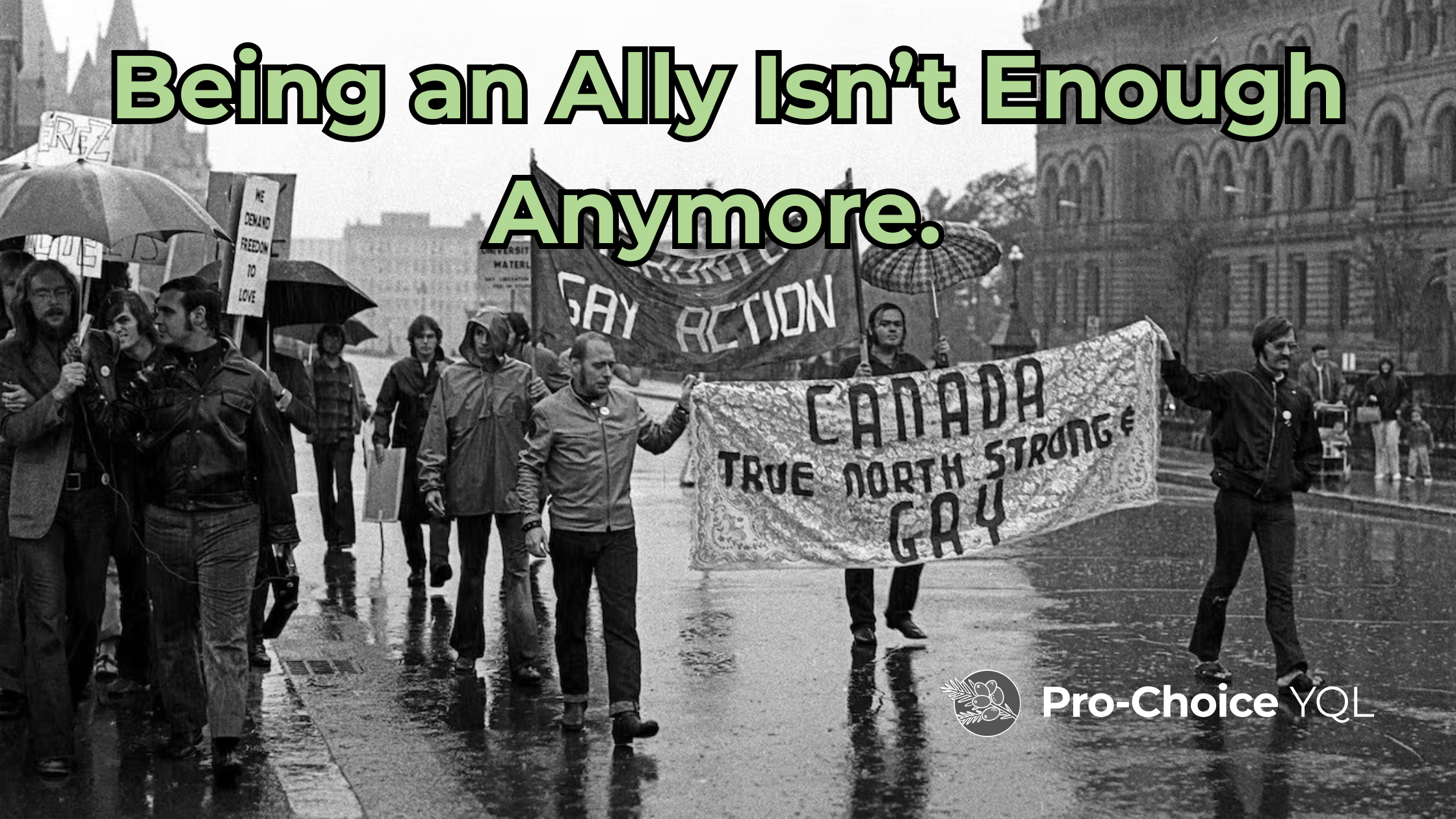
In Alberta, new transphobic legislation is being passed what feels like daily, targeting trans youth and allowing for misinformation about gender diversity to spread. In these moments, allyship cannot be passive. Queer and trans folk need allies to use their privilege to stand up for queer and trans peoples basic human rights. Below are just a few examples of ways you can become a more active ally for the community.
1.Put Your Money Where Your Mouth Is
In our capitalist society, money is power. As consumers, we can choose to use that power to support our values; and, there are tons of ways to use our consumer power to be better allies.
The most straightforward way to do this is to donate directly to charities and/or non profits that support and provide resources to queer and trans people. Some local examples are OUTreach/Raining Love, Q-Space, Pro-Choice YQL, Skipping Stone, and Lethbridge Pride Fest.
Supporting queer and trans art is another amazing way to support the queer community. Theatre Outre is a queer and trans led theatre troupe that puts on beautiful and authentic displays of anger, fear, sadness, and joy, along with a host of other events.
Another way to do this is to patron art galleries that support 2SLGBTQIA+ artists, such as Casa and SAAG. This can look like purchasing a SAAG yearly pass, keeping up to date on new instalments and making a point to visit the ones made by queer and trans artists, and attending workshops at Casa led by queer and trans people, just to name a few!
You can also choose to support more queer and trans owned & operated businesses, and ones that do significant work for the 2SLGBTQIA+ community. A couple Lethbridge examples are Theoretically Brewing and Analog Books - who also carry lots of local queer authors!
The opposite of this is to not support businesses who are openly against the 2SLGBTQIA+ community where possible. There are lots of boycott lists - such as that from Ethical Consumer - where you can search specific companies/organizations in order to see if they are being boycotted, and if so, what for. These are amazing, free resources that are readily available - if you are actively seeking them out.
If you cannot financially support these organizations, there are still tons of ways to support them! Volunteering, attending their events, or following their social media pages and reposting their content are all great options that help more than you’d think!
Additionally, be careful to avoid companies or organizations that use “rainbow capitalism” to their advantage. These companies use pride month as a marketing strategy to appear as if they support queer and trans folks, but don’t actually do anything to support the communities. Sometimes, these companies even have an internal work culture that discriminates against queer and trans employees. Some telltale signs of a company using rainbow capitalism is changing their logo to include a rainbow for the month of June, or selling Pride themed merchandise during the summer but not donating any proceeds to queer and/or trans non-profit organizations or charities. Essentially, these companies and organizations use the 2SLGBTQIA+ community and its history to manipulate buyers into purchasing from them, under the guise of support and tolerance.
2. Constantly Challenge Your Biases and Educate Yourself
It’s hard to admit it when you’re wrong or don't understand something, but constantly learning and challenging your biases is an amazing way to be an ally. Hell, even as a queer and trans person myself, there are still things I don’t totally understand, and I am regularly getting things mixed up or incorrect.
The best practice for this is to not assume you know everything, and when you hear a new term or there is something you don’t understand, make the effort to learn. Ask respectful and appropriate questions if someone is willing to share, but don’t treat them like a search engine and keep in mind that every experience is different, so you still need to take it upon yourself to do research. It’s okay not to know everything, but it isn’t okay to purposely stay ignorant.
There are also tons of free/low cost training opportunities online and in the nearby community! Check out the CBRC website for their free trainings, and keep an eye out on local social media for more local options.
Sometimes though, even after taking steps to educate ourselves, we still just can’t wrap our heads around it. At that point, ask yourself if you need to understand it for you to respect the person behind the identity. For example, a lot of people don’t understand they/them pronouns, saying that they are grammatically incorrect and don’t make sense. If this sounds like you, ask yourself if you need to fully understand the ins and outs of why someone may use they/them pronouns to respect the human that uses them. Ask what harm it does to you specifically to call that person by they/them pronouns, and then apply this thought process to a number of other examples.
3. Call Out & Call In
Believe me, I know this one is scary, but the hierarchy of violence starts at the bottom. When you hear an offensive joke or someone spreading misinformation, you can disrupt this by either calling-out, or calling-in. I would wager that calling in is the less well known phrase, so let's start there.
Calling-in is a more sympathetic and compassionate way to make someone aware that something that they have said is hurtful. Oftentimes (especially in Southern Alberta), people have been socialized in such a way where they genuinely don’t know that certain phrases or jokes are deeply offensive and discriminatory. In this case, a call-out would likely put that person on the defensive, and therefore ruin an opportunity where learning and change could take place. Examples could look like “Can you explain what you meant by…” or “I understand that it wasn’t your intent, but the impact of you saying that is…”
Calling-out is the more aggressive version. This is often used when someone says something very blatantly offensive, especially when this is a recurring issue that the person knows of, but refuses to change. Some examples are “As your friend, I’m telling you right now that's not okay for you to say” or “I will not be continuing this conversation if you continue to…”
Additionally, there are options if you aren’t comfortable or safe to call someone out or in at that exact moment. You can always pull someone aside for a one-on-one conversation where the pressure of other people isn’t as prominent. You can even send them an email or text message to have that conversation online if that's the option that is the best for you. However, keep in mind that in these cases, time is still an important factor. Do not start these conversations more than a few hours - or a day at max- after the incident occurs.
All of these options are valid and carry their own merits, and regardless of which option you choose, you let them know that this behavior is not okay and will not be tolerated by you.
Unfortunately, these situations can escalate things incredibly quickly, so use best judgement on whether or not you feel comfortable confronting someone or not. Always prioritize your safety!
4. Support us in the Voting Booth
This is one of the easiest and most important ways to support the 2SLGBTQIA+ community. Be diligent in your research of political candidates and know who is and who is not going to put forth harmful legislation towards queer and trans people. When/if these politicians get voted in, make it known that these views do not represent you. Sign petitions, attend protests, and make your voice heard.
This isn't only restricted to Federal elections, advocacy happens at every level. Don't forget to vote in municipal elections and stay up to date on local politics. This could include school boards, where many of the non-withstanding clauses are being used to discriminate against trans youth. A prime example of this is the "Fairness in Sports" Act (Bill 29) which disallows trans athletes to play, which you can read more about in the Understanding Parents’ Perspectives on “Female at Birth” Sports Policies blog post.
5. Attend Events - And Not Just the Fun Ones
Events are amazing, but too often allies are only seen at the “fun” events such as pride parades and drag shows, but so rarely at more serious events where we debatably need allies even more. Attend Trans Day of Remembrance vigils, rallies and protests, MMIW2S (Missing and Murdered Indigenous Women, Girls, and Two-Spirit people) events, and more. These are also amazing ways to get connected to the community and understand what the current needs and gaps in care are, as well as finding organizations that you can support.
Often, allies are scared to overstep boundaries by going to these events- not wanting to overstep and evade spaces that aren’t for them. And this is an understandable position to take! But these more serious events are such amazing places to learn and grow as a person, and to better understand what is happening in the community. As long as an event or space isn’t specifically advertised as only for queer and/or trans people, open-minded and kind allies are welcome. If in doubt, simply ask if allies are invited!
6. Understand the Pride Doesn’t End in June
Queer and trans folks exist 365 days of the year, and our problems and struggles impact us everyday. Pride is a great time to celebrate queer and trans joy, and to take extra time to educate yourself and reflect on 2SLGBTQIA+ history, but don’t forget about us on July 1st!
Help someone in Alberta Access Abortion
